
The ABC's of Skin Cancer
/Do you know your ABC’s?
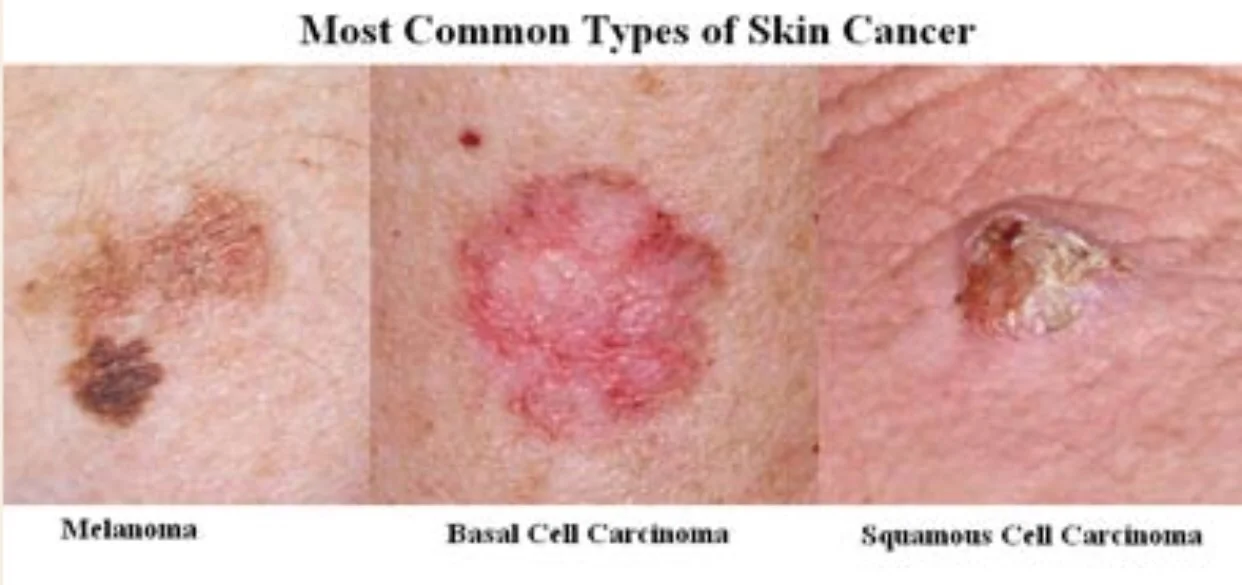
Overall there are three different types of skin cancer: Basal cell carcinoma (BCC), Squamous cell carcinoma (SCC), and Melanoma. BCC is the most common form of skin cancer and usually occurs on parts of your body that see the sun most, like your face and neck. It can appear as a waxy bump or a flat, skin-colored or brown scar-like lesion. SCC also happens in sun-exposed areas of your body but unlike BCC, shows up as a firm, red nodule or a flat, scaly or crusty lesion. Unlike the other two forms of skin cancer, melanoma can develop anywhere on your body. If you have ever been to the dermatologist, and have done a full body “scan” – this is what your doctor is looking for. Melanoma, the most serious type of skin cancer, can occur regardless of your exposure to the sun. It is most commonly found on the torso for men, and lower legs for women. The indications for melanoma are varied, but typically this type of cancer can be identified as a large brown spot with dark speckles; a mole that changes color, size or texture; a small lesion with irregular borders; or dark lesions on your palms, fingertips, soles or toes.
Melanoma is considered to the most serious type of skin cancer because there is an increased likelihood for metastasis, or spreading of the cancer to other parts of the body. This type of skin cancer develops in cells called the melanocytes. These are the skin’s pigment cells, which are responsible for skin color. Differences in skin color – whether light or dark – are due to the level of activity of these cells, not the amount of cells present in the skin. Those with fairer skin, freckles, red or blonde hair, are at a much higher risk of melanoma compared to darker skinned, darker haired people.
To help remember what to look for when scanning your body for melanomas, just think of the ABC’s. Well, the “ABCDE’s of Melanoma” that is. As most melanomas are first recognized by the person themselves, knowing what to look for can be a great help is spotting something abnormal, early. If you see a “funny looking” mole, or are starting to see new, changing or suspicious spots – this is something you should bring to the attention of a clinician. But what constitutes “funny looking” or abnormal? Below is an overview of the ABCDE’s of melanoma, to help you be aware of what to look for:
A: Asymmetry of the mole:
How to check?
Draw a line through the middle of your mole, and see if the two sides match. If the two sides do NOT match, this is a warning sign for melanoma.
B: Borders of the mole are uneven.
How to check?
Are the borders of your mole smooth and even, or jagged and uneven? Smooth and even is characteristic of a benign mole, while uneven and jagged edges are a sign of melanoma.
C: Color varies throughout the mole.
How to check?
Pay attention to the color of your mole, is it all one color? Or are there different colors throughout? Benign moles tend to be just one color of brown, while different shades of black, brown, tan (even red, white and blue) are a sign of abnormal cells and melanoma.
D: Diameter of the mole is greater than 6 mm (or the size of a pencil eraser)
How to check?
Measure your mole! Benign moles tend to be smaller, about a quarter inch wide. Malignant ones are usually larger in size, so anything bigger than a pencil eraser should be on your radar.
E: Evolution of the mole, in size, shape, color, texture.
How to check?
Be on the lookout for any mole that changes over time – whether it is the color, the shape, the size or the way it feels. Unlike melanomas, common moles look the same year after year. If a mole starts to change, itch, bleed or get scabby – get it checked!